
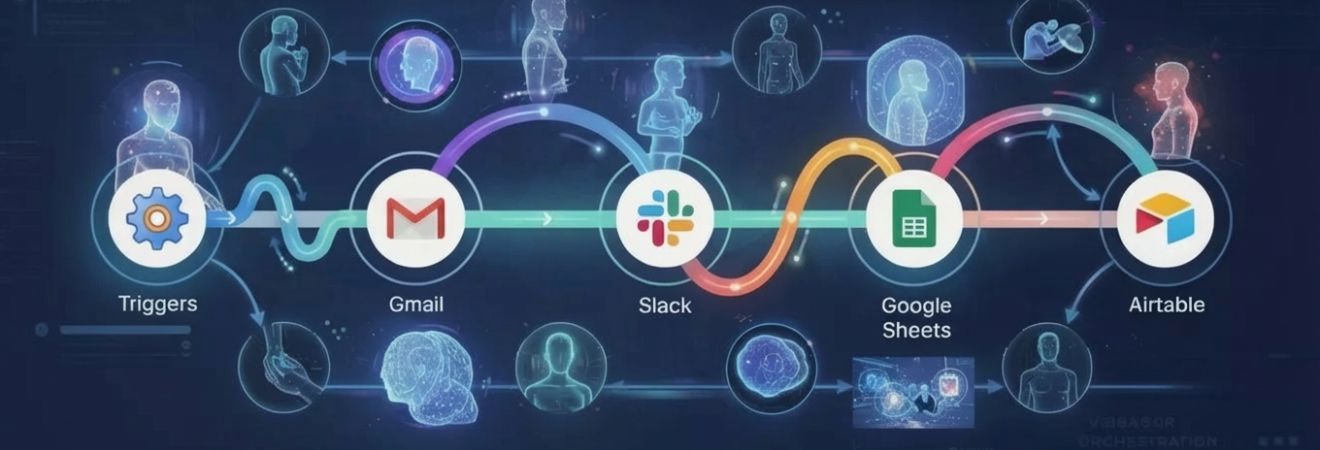
It is January 2026. Three years ago, we were amazed when ChatGPT could write a poem. Today, we don’t just “chat” with AI; we build systems where AI talks to AI, executing complex business logic that previously required entire departments.
Welcome to the No-Code AI Era.
As we settle into this new year, I want to reflect on the seismic shift we’ve witnessed. The line between “developer” and “operator” has not just blurred—it has vanished. The tools we discussed in the past (like n8n, Make, and Zapier) have evolved from simple glue code into sophisticated AI Orchestration Platforms.
Here is my perspective on where we stand in 2026 and how the integration of AI has redefined the No-Code landscape.
1. The Shift: “Automation” is Dead, Long Live “Orchestration”
In the early 2020s, “automation” meant moving data from Point A to Point B.
- Example (2023): “If a form is submitted, send an email.”
In 2026, we talk about Orchestration. This implies decision-making. We are no longer building linear pipelines; we are building cognitive workflows.
- Example (2026): “If a form is submitted, have an AI Agent analyze the sentiment, check our inventory, draft a personalized proposal based on historical pricing, and wait for human approval before sending.”
The tool didn’t just move the data; it understood the data.
2. AI Agents are the New “Apps”
We used to struggle with API limits and finding the right “connector” in a library of 5,000 apps. Today, LLMs (Large Language Models) act as universal connectors.
In my recent projects, I rarely look for a specific “Salesforce Node” or “Slack Node” anymore. Instead, I deploy AI Agents within my no-code environment.
- The Researcher Agent: Scours the web for competitor pricing.
- The Coder Agent: Writes the specific Python script needed to format a messy dataset on the fly.
- The Support Agent: Drafts responses to customer tickets and tags a human only when confidence is low.
No-code platforms have become the “housing” for these digital employees. We are now architects designing the office floor plan for our AI workforce.
3. The Democratization of “Software Engineering”
This is perhaps the most controversial yet exciting change. You no longer need to know syntax to build robust software. You need to know System Design.
In 2026, the most valuable skill is not knowing how to write a for loop in JavaScript. It is understanding:
- How data should flow.
- Where the bottlenecks are.
- How to guardrail an AI model so it doesn’t hallucinate.
Tools like n8n (which has remained a personal favorite for its self-hosted capabilities) now allow us to visually map out these systems. We are building enterprise-grade software by drawing boxes and arrows, with AI filling in the code gaps in real-time.
4. The Privacy Paradox: Why “Local” Matters More Than Ever
With AI ingrained in every keystroke, data privacy has become the single biggest differentiator for businesses.
In 2024, we worried about sending data to OpenAI. In 2026, with the rise of powerful Small Language Models (SLMs) capable of running on consumer hardware, the trend has swung back to Local AI.
I am seeing a massive migration towards “Sovereign AI Stacks.” Businesses are running open-source models (descendants of Llama 3 or Mistral) on their own private servers, orchestrated by self-hosted no-code tools. They get the intelligence of 2026 with the privacy security of 2010.
Conclusion: Adapt or Be Automated
The “No-Code AI Era” is not coming; it is here. The barrier to entry for building incredible things has never been lower, but the ceiling for what you can build has never been higher.
If you are still using automation tools just to “copy-paste” rows between spreadsheets, you are missing the revolution. It’s time to stop building pipes and start building brains.
My advice for 2026? Start treating your no-code workflows as living, thinking entities. Give them agency, give them guidelines, and watch them build your business.