
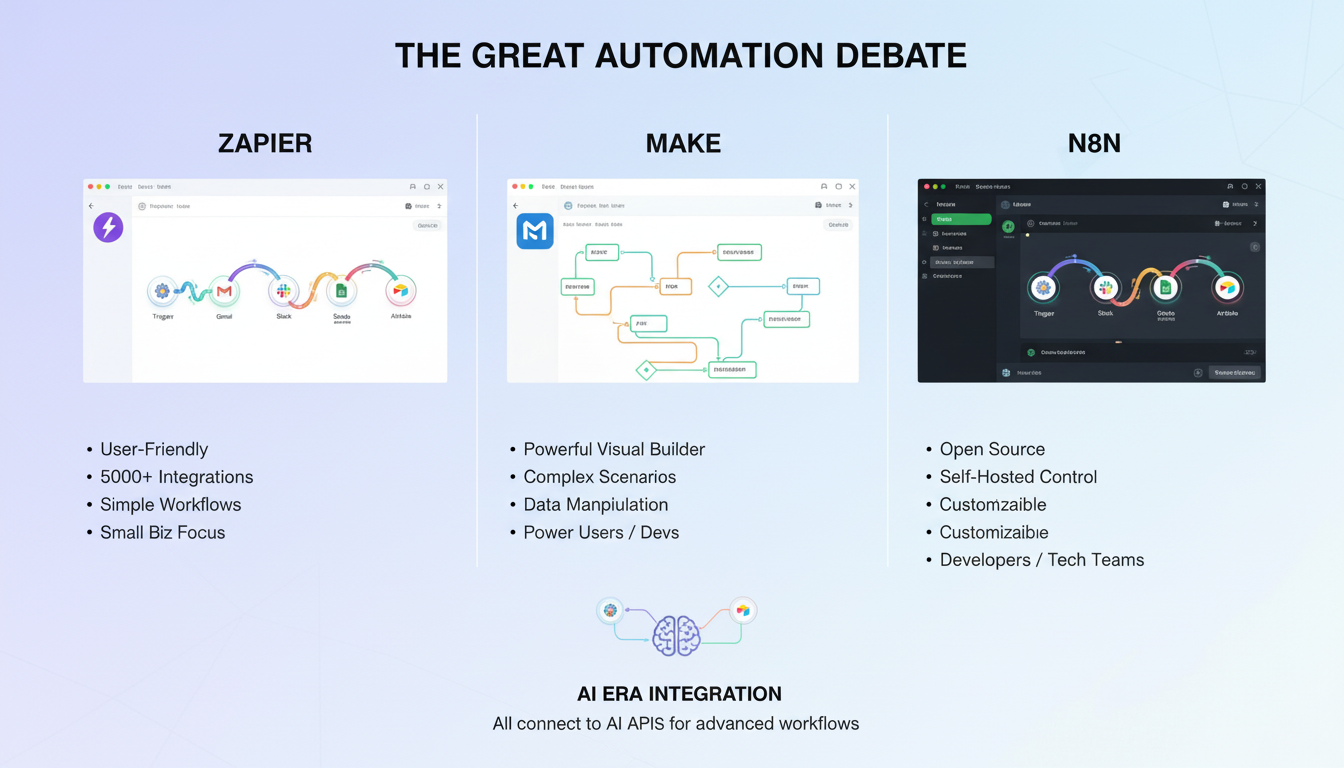
We are living in a time where “being busy” is no longer a badge of honor; “being efficient” is. In the rapidly evolving landscape of digital business, the ability to connect disparate apps, automate mundane tasks, and integrate Artificial Intelligence into daily workflows is what separates market leaders from the rest.
As we dive deep into the world of workflow automation, three giants stand out: Zapier, Make (formerly Integromat), and the open-source challenger, n8n.
In this guide, I will dissect these platforms not just as tools, but as strategic assets for your infrastructure. Whether you are a startup founder, a DevOps engineer, or a CTO, understanding the nuances of these platforms is crucial for your data sovereignty and operational scalability.
The Landscape of No-Code Automation
Before we compare features, we must understand the philosophy. “No-Code” and “Low-Code” automation tools act as digital glue. They allow your CRM (like HubSpot) to talk to your communication tool (like Slack), which then triggers your project management board (like Jira), all without writing a single line of Python or PHP.
However, the introduction of Generative AI has changed the game. Now, it’s not just about moving data; it’s about processing it intelligently.
Let’s look at the contenders.
1. Zapier: The Universal Adapter
The Philosophy: “It just works.”
Zapier is arguably the most famous name in the industry. It focuses on accessibility and breadth.
- Pros:
- Massive Ecosystem: With 6,000+ integrations, if a SaaS tool exists, it probably connects to Zapier.
- Ease of Use: The “If This, Then That” linear logic is intuitive for non-technical users.
- Reliability: It is a robust, set-and-forget SaaS solution.
- Cons:
- Cost at Scale: Zapier’s pricing model is task-based. As you scale to thousands of operations, the costs can skyrocket.
- Linear Logic: Creating complex, branching logic or loops can be cumbersome compared to its rivals.
- Data Residency: Your data flows through US-based servers, which can be a concern for strict GDPR compliance.
Best For: Marketing teams and small businesses needing quick, simple integrations without IT involvement.
2. Make (formerly Integromat): The Visual Architect
The Philosophy: “Visualize the flow.”
Make takes automation and turns it into a visual diagram. It allows you to drag and drop bubbles (modules) on an infinite canvas, connecting them with complex logic.
- Pros:
- Visual Freedom: You can see data paths, loops, and error handlers visually. It supports non-linear workflows perfectly.
- Granular Control: Excellent for manipulating data arrays, JSON parsing, and complex transformations.
- Cost-Effective: Generally cheaper than Zapier for high-volume tasks.
- Cons:
- Learning Curve: It requires a bit more technical understanding of APIs and data structures.
- SaaS Limitations: Like Zapier, it is a cloud-hosted solution, meaning you rely on their infrastructure and uptime.
Best For: Operations managers and technical marketers who need complex logic and data transformation capabilities.
3. n8n: The Sovereign Powerhouse
The Philosophy: “Fair-code and Freedom.”
n8n is the disruptor. Unlike the others, n8n is “fair-code” (source-available), meaning you can download it and host it on your own servers (Self-Hosted).
- Pros:
- Data Sovereignty: This is the game-changer. You can host n8n on any VPS or Cloud Server. Your data never leaves your control. Crucial for privacy-sensitive industries (Finance, Health, Gov).
- Unlimited Execution: When self-hosted, you don’t pay per task. Your only limit is your server’s CPU and RAM.
- Developer Friendly: It offers a low-code UI but allows you to write raw JavaScript for limitless customization.
- Cons:
- Maintenance: “With great power comes great responsibility.” You need to manage the server/Docker container yourself.
Best For: CTOs, Developers, DevOps teams, and enterprises prioritizing data privacy, security, and cost-control at scale.
Comparison Table: At a Glance
| Feature | Zapier | Make | n8n (Self-Hosted) |
|---|---|---|---|
| Hosting | SaaS (Cloud) | SaaS (Cloud) | Self-Hosted / Cloud |
| Privacy | Third-Party Control | Third-Party Control | 100% Your Control |
| Pricing | Per Task (High) | Per Operation (Medium) | Server Cost (Low/Fixed) |
| Complexity | Linear / Simple | Visual / Complex | Visual / Code-Heavy |
| AI Readiness | Good | High | High (LangChain Integration) |
The AI Connection: Automation Meets Intelligence
The future isn’t just about moving data; it’s about thinking. All three platforms now integrate with LLMs (OpenAI, Anthropic, etc.).
However, n8n shines brightly here with its specialized AI Agent nodes and LangChain support. This allows you to build custom AI chatbots or internal tools that run on your own infrastructure, potentially connecting to local LLMs (like Llama 3) for ultimate privacy.
Imagine a workflow where customer emails are analyzed by a local AI model on your server, categorized, and drafted—all without the data ever touching a public cloud API. That is the power of self-hosted automation.
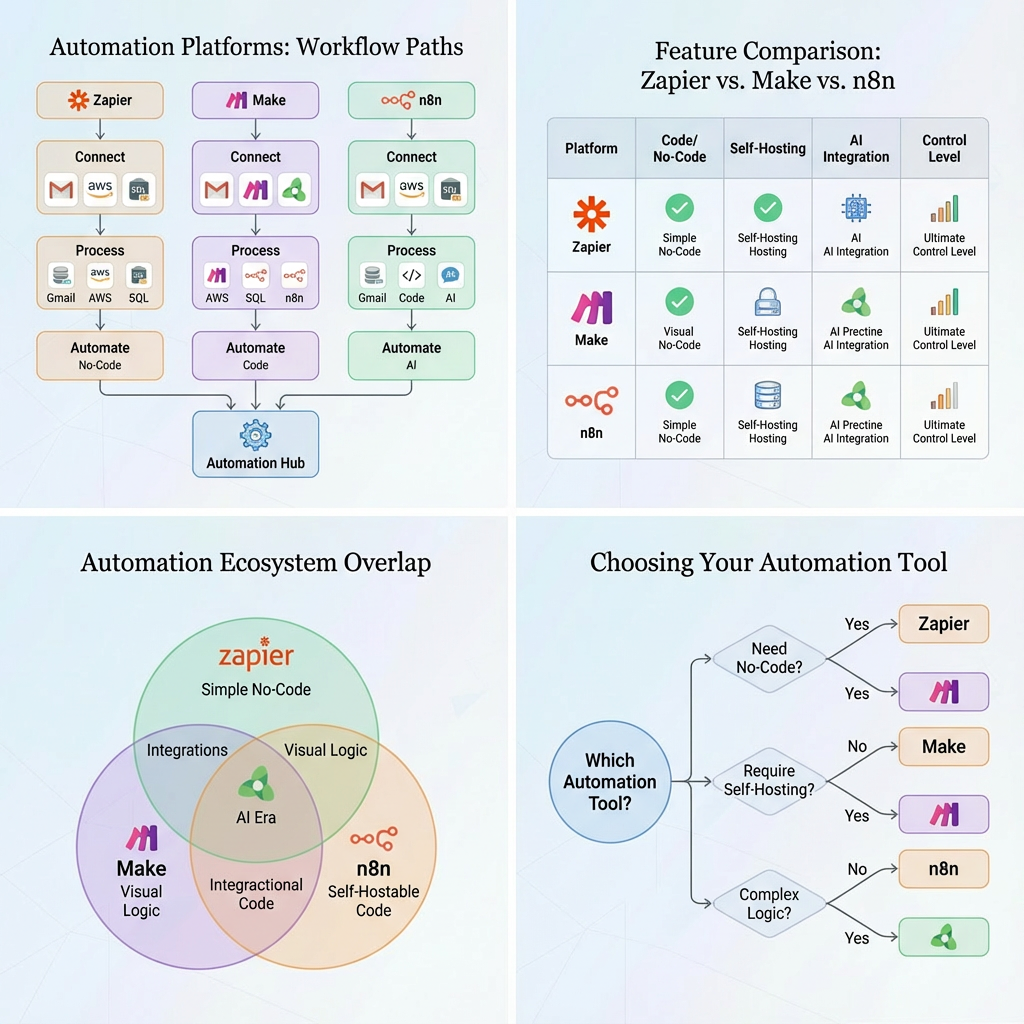
Conclusion: Which One Should You Choose?
The decision ultimately comes down to your infrastructure strategy and technical capability.
- Choose Zapier if you have zero technical resources and budget is not a primary constraint.
- Choose Make if you love visual logic and need to build complex scenarios without managing servers.
- Choose n8n if you value Data Sovereignty, want to avoid “vendor lock-in,” and are ready to leverage robust infrastructure to run unlimited workflows at a fixed cost.
In my experience, empowering users with control is the most sustainable path forward. While SaaS tools have their place, the freedom of self-hosted solutions like n8n aligns perfectly with the future of secure, scalable, and independent digital business.
Pingback: The No-Code AI Era: 2026 Trends in AI Integration - Fatih Battal